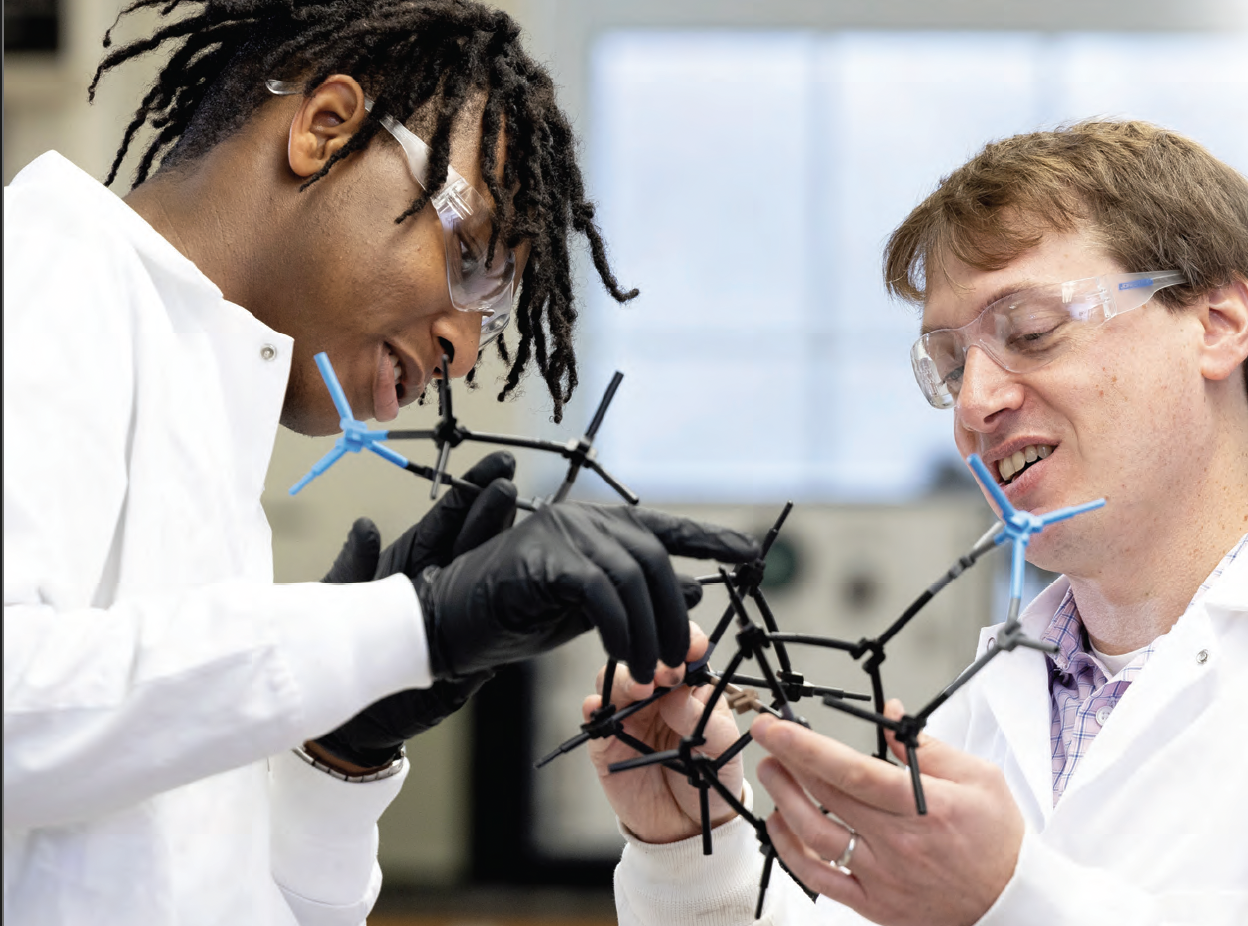
Research by Albright College students, alumni and faculty has been accepted for presentation to the American Chemical Society this March.
Nearly as old as Albright College, the American Chemical Society is one of the world’s largest scientific organizations with more than 200,000 members across 140 countries. Thousands of members gather to share ideas and advance scientific and technical knowledge during the American Chemical Society conference, March 17-21 in New Orleans, La.
Accepted research includes:
“Multi-metallic complexes supported by a PNP/NNN-ferrocene ligand”
Jy Jackson ’25, Daniel Petersheim ’21, James Allen ’18, professor Nicholas Piro
Division of Inorganic Chemistry
ABOUT: Nature is the most successful chemist for activating and interconverting small molecules, and a key feature of many enzymes that carry out these transformations is their asymmetric, bimetallic active sites. In this study, the authors describe the synthesis of bioinspired multi-metallic complexes that incorporate a PNP/NNN-ferrocene ligand with pendant bis [2-(diphenylphosphino) ethyl]amine (PNP) and dipicolylamine (NNN) chelates. Discussions of multi-metallic complexes include the synthesis and structures of dizinc and diiron complexes of this ligand as well as attempts to synthesize other multi-metallic systems.
“Plasmon driven chemistry of viologen derivatives”
Tara Huffman ’24, professor Matthew Sonntag
Division of Colloid & Surface Chemistry
ABOUT: The excitation of surface plasmons in nanoscale materials leads to the generation of enhanced local electric fields and hot carriers. By placing certain analyte materials on the surfaces of these materials the plasmons can induce chemical reactions that would not occur under standard conditions. The researchers synthesize silver nanoparticles in order to study the reactivity of a series of viologen derivatives under these conditions.
“Deuteration via electrophilic aromatic substitution in a course-based undergraduate research experience (CURE-d)”
Stephanie Brown ’24, Cayla Newkirk ’23, Kevin O’Rourke ’23, Justin Stricker ’23, Shivangi Thakur ’23, Maddison Wagner ’23, professor Christian Hamann
Division of Chemical Education
ABOUT Deuteration is a well-established technique for the investigation of molecular structure and function, yet this chemistry is underrepresented in the undergraduate curriculum. The authors describe a reasonably economical approach to a deuteration reaction performed in the course-based undergraduate research framework, a pedagogic approach dubbed CURE-d. In general, CUREs provide students and their faculty with the opportunity to produce publishable results within the timeline of the academic year. CUREs invite greater numbers of students than the classical independent study to experience the joys (and frustrations) of research. Using this approach, students are actively encouraged to apply material from prior or current courses as they learn new laboratory techniques and problem-solving skills. CUREs have quickly become an educational best practice and the opportunities for implementation are seemingly unlimited. In this CURE-d, students pursued the synthesis of 1,4-bis(1,1-dimethylethyl)-2,5-dimethoxybenzene specifically deuterated at the 3 and 6 positions. The target compound, useful for the analysis of rechargeable lithium ion battery performance, has not been synthesized previously. This progress report includes notes on the synthesis of the novel target compound using deuterated water and trifluoroacetic anhydride followed by structural characterization using NMR spectroscopy. The determination of percent deuteration as well as possible loss of the alkyl sidechain is discussed. In addition, approaches taken by students to prepare their work for presentation are considered. Overall, one goal for this work is to build awareness of CURE-d and deuteration reactions in general, moving this important tool into the hands of undergraduates.
“Investigating an enzyme mechanism using computed NMR spectra of patchouli oil epimers”
Professor Christian Hamann, Dean Tantillo (UC Davis)
Division of Computers in Chemistry
Session Type: Poster – In-person
ABOUT: Patchoulol synthase catalyzes the conversion of farnesyl diphosphate, a linear compound, into patchouli alcohol, which is a tricyclic tertiary alcohol that provides the characteristic fragrance note of patchouli oil. Overall, this investigation seeks to provide computational support for the chemical mechanism of patchoulol synthase. One open question is whether this enzyme utilizes an isomerase activity that converts the farnesyl moiety [(2E)-configuration] found in the starting material to the diastereomeric nerolidyl moiety [(2Z)-configuration] early in the reaction pathway. If this is the case, all subsequent products (and byproducts) would contain either the corresponding alkene configuration or the corresponding absolute stereochemistry of the C2 and C3 stereocenters (reflecting retention or inversion of configuration, depending on the details of later steps). Computed NMR spectra provide support for these mechanistic analyses since diastereomers have different chemical shifts (barring accidental magnetic equivalence). However, conformational flexibility can complicate this approach: since NMR spectra reflect conformational averaging in the solution phase, predicted NMR spectra must include the Boltzmann-weighted contribution from all conformers present in solution. Fortuitously, the rigid structure of patchouli alcohol makes it an ideal candidate for computed NMR analysis because only one conformer is present in solution at room temperature. Patchoulol synthase also generates a panel of constitutionally isomeric hydrocarbon byproducts representing intermediates along the reaction pathway that must be accounted for in any proposed enzyme mechanism. Three tricyclic hydrocarbon byproducts – seychellene, α-patchoulene, and δ-patchoulene – are also welcomed candidates for computed NMR analysis because their rigid structures only allow for one conformer each in solution. In summary, computed NMR spectra can be compared to solution NMR spectra to support (or refute) the overall enzyme mechanism of patchoulol synthase including a previously unknown farnesyl-nerolidyl isomerase activity.
“Introductory computational exercise for physical chemistry students”
Professor Matthew Sonntag
Division of Physical Chemistry
ABOUT: The use of computational tools to enhance understanding of chemical concepts is becoming common place in the undergraduate curriculum. In this exercise we introduce students to various computational calculations through several straightforward exercises. These activities are related to past material they have seen in our curriculum including organic and general chemistry courses and lay a foundation for further computational work during the course of the two semester physical chemistry sequence.